zondag 4 maart 2018

Having it all

As we read in last week's readings, Hollywood usually treats successful women's coming of age moments as wild women losing their wild side and learning to become good, pretty women who are destined to be fine wives for their future husbands. Mary Ann Doane describes the quiet and unattractive women having to undergo the same transformation of having to look beautiful and smile prettily at men in order to be seen as a complete woman. They even have their glasses taken away so they forever will be objects of the gaze.

"Why can't we have both?" They must have thought in 2001 (which is 17 years ago now), when one of the most progressive and feminist films released in theaters, or so I will argue in this post.

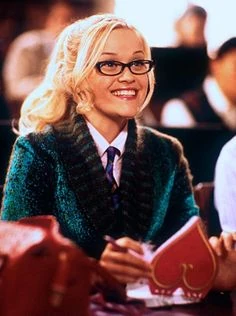
The story of Elle Woods' journey to become a complete woman includes embracing her reading glasses, instead of shedding them. What starts as a stereotypical race to recapture her man's heart, ends with the realization that she is her own person, her happiness should be a result of her own actions and not male attention.
Traditionally, in order to be considered attractive or successful (which is often regarded as the same really), women had to chose in Hollywood movies. While looks are important, that often meant more serious things weren't meant for the woman. Brainiacs or ambitious lead female roles were about the realization those ambitions were more important than frivolous  pink dresses or incredible nail art. Ambitions don't mash well with pink and other hyper-feminine stereotypes.

But for Elle Woods in Legally Blonde, she can have it all and look good doing it.

Afbeeldingsresultaat voor Elle woods

zaterdag 3 maart 2018

Breaking The Masculine Masquerade: James Charles


Voyeuristic pleasure, as Mulvey argued, where the man is the bearer of the look (active) and the woman the image being looked at (passive), is a heterosexual pleasure. It assures heterosexual masculinity because it demands the male spectator’s identification with the male image in order to look at women. For Mulvey, this is an easy and natural process for men. However, Bryson argued that this process is not necessarily easy, and men could face extreme difficulties. Bryson views this relationship as “enchanted” and argued that it is a simplification and pacification of the mechanism of intermale identification. 
The same goes for masculinity. Through the eyes of voyeurism, masculinity is a given fact, an interminable code. Rather, masculinity is a continuous construction (like gender). Therefore, in order to be a male subject, a “masculine masquerade” that flows out of voyeurism is demanded. 
“Deviation or failure to obey that constant injunction risks instant and severe penalties. This censorship already points to ways in which the masculine masquerade is directed not only towards women but towards other males. It points, thereby, to the anomaly in the model that I mentioned just now: that the male is not only bearer of the gaze but is also object of the gaze.” (Bryson 231).
Someone who deliberately positions himself as the object of the gaze and does not wear the masculine masquerade is James Charles. He is an eighteen-year-old so-called ‘cybercelebrity’ and a male make-up artist. He became famous because of his YouTube channel where he posts make-up tutorials. Since 2015, Charles has gained over three million followers on YouTube and Instagram. Striking is that Charles posts videos of applying make-up onto himself and not onto women.  He also became the first male spokesmodel for the make-up brand CoverGirl in 2016. Charles does not wear make-up because he wants to identify as a girl or transgender, he just likes the art of make-up. Therefore, he adopts a certain type of masculinity that breaks with traditional heterosexual masculinity. This comes with crucial difficulties as Bryson argued, since his type of masculinity does not fit the current norm of the masculine masquerade. He no longer is the subject but becomes the object of the gaze, because the audience of his social media channels are largely women who are interested in his make-up looks and skills.


 Men wearing make-up is gaining popularity on social media platforms and there are many men posting photos and videos of their make-up looks online. What is special about this phenomenon is that these men did not gain popularity because of the fact that they wear make-up. This would actually reduce their popularity since it does not fit in a heterosexual masculine environment. Rather, admiration amongst women (and men) of their skills in the art of make-up and an interest in their created looks is the reason for their high numbers of followers. However, because these boys look highly “feminized” (Neale 14), it may also confirm the argumentation that only women can function as objects of an erotic gaze. 


donderdag 1 maart 2018

The Women of Overwatch


With yesterday’s addition of Brigitte Lindholm, Overwatch now has twenty-seven heroes in their roster. Thirteen of those are women, albeit one of those thirteen is actually a robot. This is quite a lot, especially for a video game where men make up most of the target audience. Most games have, if any, one or two women in a cast of men, and usually the game’s protagonist is a man, too. An example for this would be Naughty Dog’s Uncharted series, where men always outnumber women.

For Overwatch, this seems to be a problem of the past. Upon release date the game had nine female characters, and four of the five characters that were added are women. However, with this wide variety of cast, another problem occurs: body shapes.


As Laura Mulvey mentions in her essay Visual Pleasure and Narrative Cinema, “In their traditional exhibitionist role women are simultaneously looked at and displayed, with their appearance coded or strong visual and erotic impact so that they can be said to connote to-be-looked-at-ness. Women displayed as sexual objects is the leit-motiff of erotic spectable: from pin-ups to striptease, from Zeigfeld to Busby Berkeley, she holds the look, plays to and signifies male desire.”

In Overwatch, the large number of heroes to choose from means there is a lot of room for diversity. People of a variety of races and nationalities can find themselves represented by the characters in the game. But the bodies of the female characters are not as diverse as those of the men. Eleven of the thirteen women have a thin waist and attractive facial features. Only two women break the mold: Zarya, a muscular woman with short, pink hair, and Mei, a bigger boned woman with a chubby face. Supposedly they were created after initial complaints about the sameness of the already-existing women’s body shapes.


Overwatch clearly only has this problem with its female characters, as the number of male characters vary in both size, shape, and attractiveness. From Torbjörn, a short man with a prosthetic arm who, in my opinion, looks a bit like a dwarf, to Doomfist, who’s tall, dark, and muscular. No two men look the same, not even brothers Genji and Hanzo, but for the female characters it’s very much like they just used the same mold over and over again. They play the traditional role Mulvey mentioned in the earlier quote, playing into male desire of an attractive woman to play as or with.

In conclusion, the male gaze in Overwatch, despite being a first-person shooter game, is clear and abundant. The women are purposefully made attractive, whereas this is unnecessary for men because the audience doesn’t need to be attracted to them. Or, in the words of John Berger: “Men look at women. Women watch themselves being looked at.”


zondag 25 februari 2018

Distorted Bodies & Misrepresentation in Fashion Magazines


I remember quite vividly the time I bought my first Vogue as a young girl. It was October and the year was 2008. Even though this may seem like quite a while ago, the images I encountered while entering a new, and distorted, world in which bodies seemed so disintegrated and out of touch became a mystery to me. As I could not grasp the reality of these altered bodies, I came to the realisation that the way female bodies are represented just could not be real.

Years have gone by, but the images fashion magazines put out are far from tangible. As a consequence, disproportioned body parts and the excessively manipulated physique and figure has become the norm. Why is that? As Pollock points out, ‘the body has come to signify “sale”’ (138): it has been commodified and objectified.


However, what is left of a woman’s femininity when other subjectivities are imposed on her, is a mere illusion : an illusion purposefully created, and manipulated, so that others attempt to live up to this norm as well. According to Berger, this is ‘a sign of submission to the owner’s feelings, or demands’ (52). It this case, ‘the owner’ relates to the owner of the fashion magazine or clothing store.

However, the display of femininity seen in fashion magazine is actually a ‘masquerade’ (Doane 225), it is over the top and exaggerated. In fact, the representation is carefully crafted in accordance with what a woman decides to demonstrate as being a woman’s body (225). It is exactly this idea that should be highlighted most of all: if a woman has the power, i.e. the agency, to decide to reproduce what is considered to be feminine, does she then not have the power to produce what she finds to be feminine? In line with this believe, the tool is there to prevent young girls from having to deal with unrealistic expectations.

Stranger by the Lake

Mulvey writes, in “Visual Pleasure and Narrative Cinema,” about how the gaze is structured is Hollywood films, specifically how we are encouraged to look at women, and how there occurs a kind of ‘masculinization’ of (all of) our spectatorship. She acknowledges that there exists a branch of filmmaking (a vast and varied branch!) which challenges the viewer to look in a different way. She states that this “alternative cinema provides a space for a cinema to be born which is radical in both a political and an aesthetic sense and challenges the mainstream assumptions of the mainstream film” (834). Here I will explore one such film which challenges, rather than reinforces, the norms and assumptions which inform how we look (and how we are encouraged to look).


The 2013 French film Stranger by the Lake (L'inconnu du lac), directed by Alain Guiraudie, is described as follows on IMDb: “A cruising spot for men, tucked away on the shores of a lake. Franck falls in love with Michel, an attractive, potent and lethally dangerous man. Franck knows this but wants to live out his passion anyway.” I will not be paying much attention to the plot of the movie - how it “joins sex and death, pleasure and guilt, pleasure and pain” (Brody), but rather will focus on how it works to structure the gaze of the audience.


Lit up by the lambent sunshine of southern France deep in the summertime, the film is populated solely by men; not a single woman is seen. Already this problematizes some of the ideas laid out by Mulvey in “Visual Pleasure and Narrative Cinema;” what happens when there are no women to be looked at? (Of course, as I stated above, Mulvey was writing specifically about a particular ‘genre’ of film). The question now is not about how we are encouraged to look at women; it is about how we are encouraged to look at men. 


Stranger by the Lake contains multiple long, lingering shots of naked men lounging about on the lakeside beach, and in the luxuriantly vegetated hills rising up beyond it. The audience watches as men stroll about, eyeing each other up - our gaze (that is, the audience’s) is filtered through the sexualized gaze of the cruisers themselves. Their sexuality is the first thing we see when we see the men, they are equal to their sexuality (and its complexity).


Where in mainstream film the “burden of sexual objectification” is rarely placed on the male figure [who] cannot bear [it]” (Mulvey 838), in Guiraudie’s film men are often presented as sexual objects, willingly on display. If “man is reluctant to gaze at his exhibitionist like” (838) then this film is sure to provoke feelings of discomfort and unease in its (straight male) viewers. Dryer states that “the penis can never live up to the mystique implied by the phallus” (71) and for this reason phallic symbols are usually inserted into images of naked men to compensate. Many of the men we see in Stranger by the Lake are not accompanied by any such symbols; they appear lying about in the grass or on the beach. In the patriarchal tradition women are often located ‘closer to nature’ - taking direction from desire, passion overriding ‘rationality’ - in this film this idea is inverted, the men appear ‘at home in nature.’  


References: (excluding readings from the syllabus)

Brody, Richard. "Silence Equals Death in 'Stranger by the Lake.'" The New Yorker, 2013. https://www.newyorker.com/culture/richard-brody/silence-equals-death-in-stranger-by-the-lake.

http://www.imdb.com/title/tt2852458/


woensdag 21 februari 2018

The New Gaze in Hip Hop

The New Gaze in Hip Hop


“A woman’s presence expresses her own attitude to herself, and defines what can and cannot be done to her. Her presence is manifest in her gestures, voice, opinions, expressions, clothes, chosen surroundings, taste – indeed there is nothing she can do which does not contribute to her presence.” (Berger, 46)

According to Berger, woman’s presence in art is always a matter of women themselves but not so much their relation to the outside world. Therefore, the quote suggests that woman’s presence is about what can be done to her but not by her. This leads Berger to state that women constantly survey themselves while being surveyed by others which turns them into an “object of vision: a sight” (46-47). However, is Berger’s analysis of mainly European art masterpieces still relevant in today’s pop culture?

Cardi B
Recently, I have been especially interested in female rappers as I think they are a great source of women empowerment. Not only they embrace their sexuality and body but also, they shift the stereotypes of typically male-dominated hip-hop scene. One of the emerging artists that risen to the top is Cardi B, a former stripper from the Bronx, who is now at the top of US charts in combination with two Grammy nominations. Her past is often thrown at her and used to define her, which places Cardi B into a position of being a voyeuristic spectacle. However, she doesn’t care – she is proud of her present because that is what matters now. In her texts, she depicts men as weak, soft, and easily manipulated (MacPherson 2017). This can be linked to Griselda Pollock’s essay What’s Wrong with Images of Women as there she describes how the use of male/female reversals can be useful in denaturalizing the meanings of masculinity and femininity (137-138). Cardi B especially blurs the notion of sexual difference as she as an artist creates “an alternative imagery outside existing ideological forms” (142).
For instance, in her video clip, Bodak Yellow the opening scene in the desert creates an Orientalist vibe - Cardi B in abaya dress sits on a camel and is accompanied by seven guards who protect her in the desert. She is always in the center of the composition of the frame and is portrayed with objects of power as for instance - a cheetah, diamonds, and expensive cars. Even though Berger might interpret her presence in this video as a definition of what can or cannot be done to her, I have to disagree. I think her presence here can be also taken from a different perspective because she already reversed the typical roles of hip-hop music video where we would probably imagine a male rapper surrounded by a harem of women in this type of Orientalist scenario. By doing that, Cardi B is not only conscious of her being observed but she works within this reality and thanks to the already-mentioned reversals she is able to act outside the domain of mere video clip. We as voyeurs become shocked by this reversal and we either accept it or deny it which also connects to the statistics of her fandom which from 95% consists of females (MacPherson 2017). Therefore, we might see a positive shift in popular culture where different strategies can be adopted by women artists in order to avoid the typical representation of women as passive objects of gaze and desire.


Tatarka

Another example where women empowerment might function as an active strategy in hip-hop culture is Tatarka’s work. Tatarka is from Tatarstan and she became particularly popular for her Tatar or English tracks Altyn and Pussy Power. Her latest track Pussy Power was rapped in English and was said to be a feminist project which had an international interest (The Calvert Journal 2017). The video shows Tatarka with a group of women in 90s suits which according to her were meant to represent power and feminism (The Clavert Journal 2017). The video clip does not show any men which is very rare in the music industry. Furthermore, all the women in the video are always standing or moving in a masculine and powerful way – the women face us up front. By the end of the video, it almost seems arrogant and intimidating but when we again do the male/female reversal, it suddenly alarms us how normal the video would be if only men were there and acting in the same way. It is this confusion that some work was actually done for the female observer that makes us realize how the male point of view is so naturalized in our society. To conclude, I have to say that there are certainly many examples where Berger’s insights are still applicable, however, via this blog entry I have tried to outline examples that actually show the opposite and might lead to a more positive view of the future that can possibly depict women in a non-stereotypical and active manner which might alter the way how they are seen.


Works Cited
John Berger, Ways of Seeing

Griselda Pollock, “What’s Wrong with ‘Images of Women’?’

zondag 18 februari 2018

Hair in women's shaving advertisements

In Ways of Seeing Berger argues that in European nude paintings women are generally painted without body hair in order to appeal to the man's sexuality: "Hair is associated with sexual power, with passion. The woman's sexual passion needs to be minimized so that the spectator may feel that he has the monopoly of such passion" (55).

Similarly, in contemporary advertisements for shaving products women are shown shaving their legs or armpits that aren't even hairy to begin with (https://www.youtube.com/watch?v=w5wzBElY0k0; https://www.youtube.com/watch?v=vsyP9UucYhM). This illustrates that women in the 21st century are still not depicted with body hair. Even if the sole purpose of the advertisement is to sell a product that would get rid of the hair it is apparently too inappropriate or grotesque to see these women actually shave their hairy legs. Wouldn't an advertisement that demonstrate that the product can in fact do what it promises be more convincing?

This raises the question whether it is still the case that hair is associated with sexual power or passion and therefore has to be suppressed, or minimised, in women, as Berger suggests, or that women's body hair has become something that doesn't fit in with the beauty ideal and therefore cannot be appear on television. Either way, the ads emphasise that there is a difference in the acceptability of hair in men and women. This advertisement for men's shaving products shows the contrast: https://www.youtube.com/watch?v=2T1CaF4TsWE. Firstly, in this advertisements we can actually see the hair before it gets removed by the product in question. Secondly, basically all advertisements for men appear to be concerned with facial hair, not body hair. This suggests that body hair isn't even a issue with men, whereas with women it is. It  also clearly shows a contrast between the beauty standards for men and women.